
Your Black Friday deliverability is decided in October
The 90-second read
BFCM planning usually starts with offers, creative and the send calendar. Deliverability tends to be an afterthought, often when something has already gone wrong. The turkey can wait until November. Deliverability can’t. Mailbox providers don’t see the weeks of planning behind a Black Friday campaign. They see the pattern and the deviation from it – the volume arriving and how recipients react to it, and they decide on that basis.
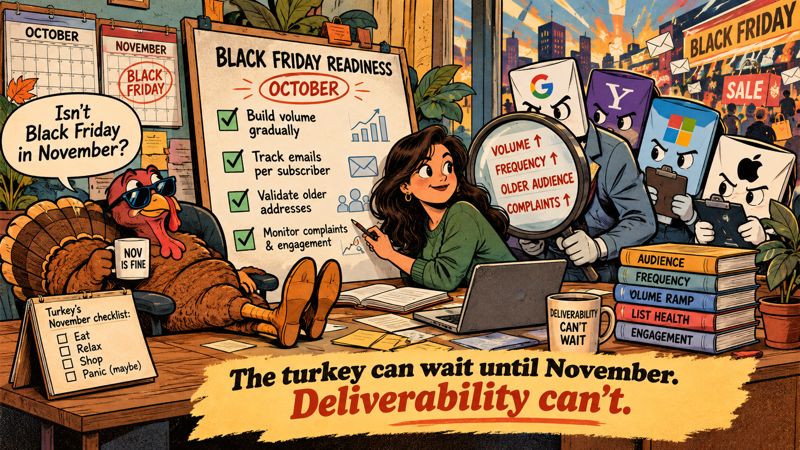
For most programs, November changes three things at once. Volume goes up, often sharply. Each subscriber receives more email, from promotions and from the triggered messages driven by what they do or don’t do. And the audience widens, as older and less engaged addresses come back into the sends. All of this is normal for the season but all of it is also what a mailbox provider is watching.
Before the volume rises, prep right:
- Build up to your peak volume gradually. A sudden spike looks like spam behavior.
- Keep track of email per subscriber, across every stream. The subscriber inboxes are flooded with promotions, you think in terms of campaign, they see the multiples.
- Validate addresses you haven’t mailed in a long time before they go back into your sends.
Then watch both sides of the engagement. While opens are a helpful indicator, clicks and purchases show you what is working. Spam complaints and unsubscribes show you how your promotions are being received. A program that ignores the negative engagement has to rely on the judgement of the mailbox providers.
If someone tells you this week that every brand sends more in November, you should say, “The ROI will depend on how much of it reaches the inbox.”
The five-minute read
Deliverability is a must-have
Picture this – your promotions have been performing well but your Black Friday sends will also go out to seasonal shoppers, inactive buyers, some of the new recipients who haven’t heard from the brand since spring, and some might even be in your lapsed buyers list brought to life for special promotions to win-them back. More sends, increased frequency, deeper audience targeting, doesn’t mean more revenue, it means more caution. The promotions that performed well all through October offer no collateral when they go out to double the usual audience, with a lot of unknowns. Instead, the reality would look a lot like this – a few of those addresses bounce. A few people unsubscribe, and the real risk is subscribers who don’t remember subscribing will click “Report spam.”
On its own, each of these is a small signal shaping your deliverability status. Together, arriving in a single day at double the volume, they look to a mailbox provider like a sender behaving very differently from the one it knew a month ago. The filtering that follows is a response to that change, not a penalty for one bad email.
Each section below covers one of those signals, and what you can do in October so it doesn’t show up in November. In deliverability, there are no quick fixes.
How much you can scale depends on the reputation you bring
A sudden spike in volume, such as doubling your sends, can cause short-term filtering and, for some senders, longer-term deliverability problems. How much it hurts depends on where you start. A sender with healthy engagement across Gmail, Yahoo and Microsoft has more room to grow. A sender that is already seeing elevated complaints at a mailbox provider will meet more aggressive filtering based on the historic patterns.
Each mailbox provider, Microsoft, Apple, Gmail, and Yahoo (known as MAGY), representing the four largest consumer mailbox providers, has its own filtering algorithms. While smaller mailbox providers like Comcast and others have fixed daily throttling limits. What holds for every program is the shape of the increase: build toward your peak over a few weeks, starting with your most engaged subscribers, rather than in one jump.
Count emails per subscriber, not per campaign
Higher frequency is part of BFCM, and it should be. Morning and evening promotions, extended sales and last-chance reminders are what the season is made of. The point is that these are not the only emails a subscriber receives. Behavioral-driven triggers like browse, cart and post-purchase rise with it, and they land in the same inbox as the promotions.
So the number to plan around is the total each subscriber receives in a day and in a week, across every stream. Increase it on purpose, for the segments that are engaging, and let the less engaged segments on a lighter cadence.
Before you reach back to older subscribers
Every BFCM season brings the same temptation: the subscribers who haven’t engaged in a while, or haven’t heard from you in a long time, look like revenue waiting to be collected. Some of them are. Not every inactive subscriber is a lost one, and a program that cuts too deep loses people it could have brought back. The question is not whether to keep them but how to approach them safely.
How long someone stays “active” depends on your next purchase window. An apparel or beauty shopper who hasn’t engaged in three or four months may be drifting. A furniture or jewelry customer may simply be between purchases, and their window should match how often people actually buy from you. That inner window is your decision.
When you do reach further back, do it deliberately. Mailbox providers will judge that send on the signals it generates. Yahoo treats a mailbox as inactive after 12 months without a sign-in. Outlook.com freezes inactive mailboxes after a year. Gmail deletes accounts that haven’t been used in two years. Abandoned addresses can later be converted into spam traps, and the industry’s anti-abuse working group, M3AAWG, describes 12 months of inactivity as the minimum before that happens.
That leads to a simple sequence:
- Validate first. Run addresses through an email validation service before they go back into your sends.
- Win them back as a lifecycle moment, not a promotion. A triggered message sent when someone enters their lapsed window has a better chance than a bulk send to everyone at once. Tailor the incentive: a customer who has bought from you several times should not get the same offer as someone who never purchased.
- Know when to stop. If they don’t respond, reduce your cadence to targeted promotions only. Repeating the same win-back send is not a strategy.
The same care applies to newly imported addresses. Confirm how they were collected, consent is the king. Start with a sample check rather than adding them straight into a full promotional send.
Read both sides of engagement
Mailbox providers weigh how recipients respond more than anything else. Positive engagement, clicks, purchases and replies, tells you who wants more of your mail. Negative engagement, spam complaints and unsubscribes, tells you how your promotions are actually landing.
Google asks bulk senders to keep their spam rate below 0.3%, with 0.1% as the level to aim for. Modern day inboxes are governed by engagement and relevance – a proactive deliverability is therefore a must-have for the success of an email program.