




Customer Movement
How Modern Retail
C-Suites Are
Approaching Growth
Retail executives are expected to deliver ever-increasing growth and EBITDA — even in the face of inflation, high interest rates, geo-political conflict, global economic challenges, continuous channel expansion, and ever-changing consumers.
Digital and customer-centric transformations implemented over the past 15 years have set foundations for retailers and brands to more rapidly adapt to external dynamics. The impetus of this work is the recognition that customers are any organization’s most valuable assets: more valuable than even the brand or products, both of which evolve in response to customers.
Yet even as they understand the importance of their customer file, organizations are still at odds with their customers. For retailers and brands, the goal is for consumers to wake up every day and spend. Yet consumers don’t wake up thinking about ways to part with their money.
Some of the effects of this misalignment are immediate: missed comps, inventory surplus, discounts that sabotage revenue, and misdirected marketing spend. In the longer term, brands see low retention rates, low margins, depressed shareholder value, and reduced cash flow. Every year becomes more difficult than the last, and growth stalls out.
In an effort to become more aligned with their customers, an increasing number of retailers are marrying modern open-to-buy planning and a new strategy: customer movement.
Customer movement is a framework based on metrics directly tied to customer behavior rather than channel behavior. And it helps brands better understand the health of their customer file and the opportunities for growth.
Customer movement puts retailers and brands in control of both retention and acquisition, which is hugely preferable to spending on a channel and hoping for a positive outcome. It helps place a valuation on the current state of the business by offering insight and predictability into the spending of existing customers. It addresses inventory risk by forecasting based on known buying behavior. And it helps leadership collaborate with each other and their boards to increase free cash flow today while paving the way for long term, efficient growth.
This C-suite framework for discussions around investment, payback, and gains in revenue and profitability helps functions across the organization work together to better understand the ROI on new-customer acquisition, and to build retention, acquisition, and merchandising strategies.

Customer obsession in an era of customer control
Many leaders believe that their organization has already ‘solved’ for customer obsession. But a comprehensive customer-first approach is a far more radical endeavor than most retailers have yet attempted. It requires not just a new mindset, but the appropriate framework and execution to support it.
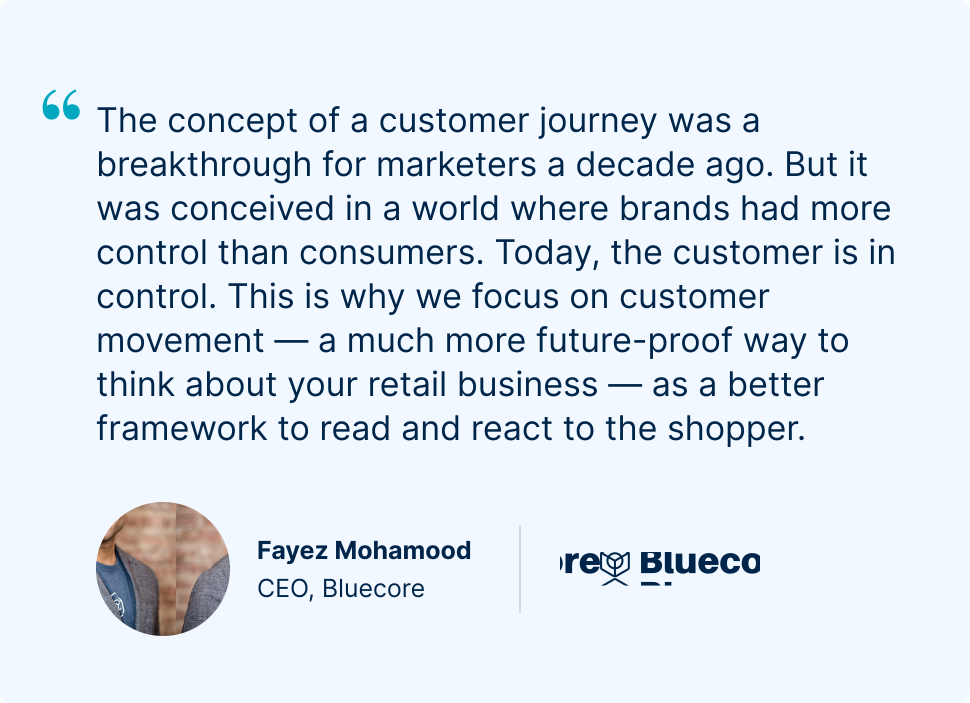
Becoming customer-first is an organization-wide initiative, and customer movement can help unify and guide that effort.
It begins with the understanding that your customer file is your most important asset. A proper analysis of that file becomes the single best indicator of the current health of your business. A customer-first mindset further means that the organization collects and takes guidance from customer-level metrics, such as retention rate, purchase rate, number of orders, and sales. Channel metrics are used in support of these, but are not ends in themselves.

Understanding customer movement
Customer movement acknowledges that customers are always moving through the customer lifecycle, toward retention or churn. Brands have the ability to influence that movement through signal-based messaging that is personalized, relevant, and timely. The first step in understanding your organization’s customer movement is to diagnose the health of your customer file.
Bluecore works with customers to provide a Customer Movement Assessment. In this analysis, customers are divided into three cohorts:
- Active buyers: Those who have made a purchase in the past year
- Inactive buyers: Those who have purchased, but not in the past year. These are further sorted by the amount of time since their last purchase: 13-24 months, 25-36 months, and 37+ months.
- New buyers: Those who made their first purchase with the brand within the past year
Within each cohort, a Customer Movement Assessment examines metrics such as purchase frequency, total orders and sales, average order values, and retention rates. Among inactive buyers, the assessment tracks reactivation rates. It allows brands to see common weaknesses, such as a failure to retain customers within a given cohort, or low average order values.
When customers make a purchase, they move up and to the right in the customer movement table.
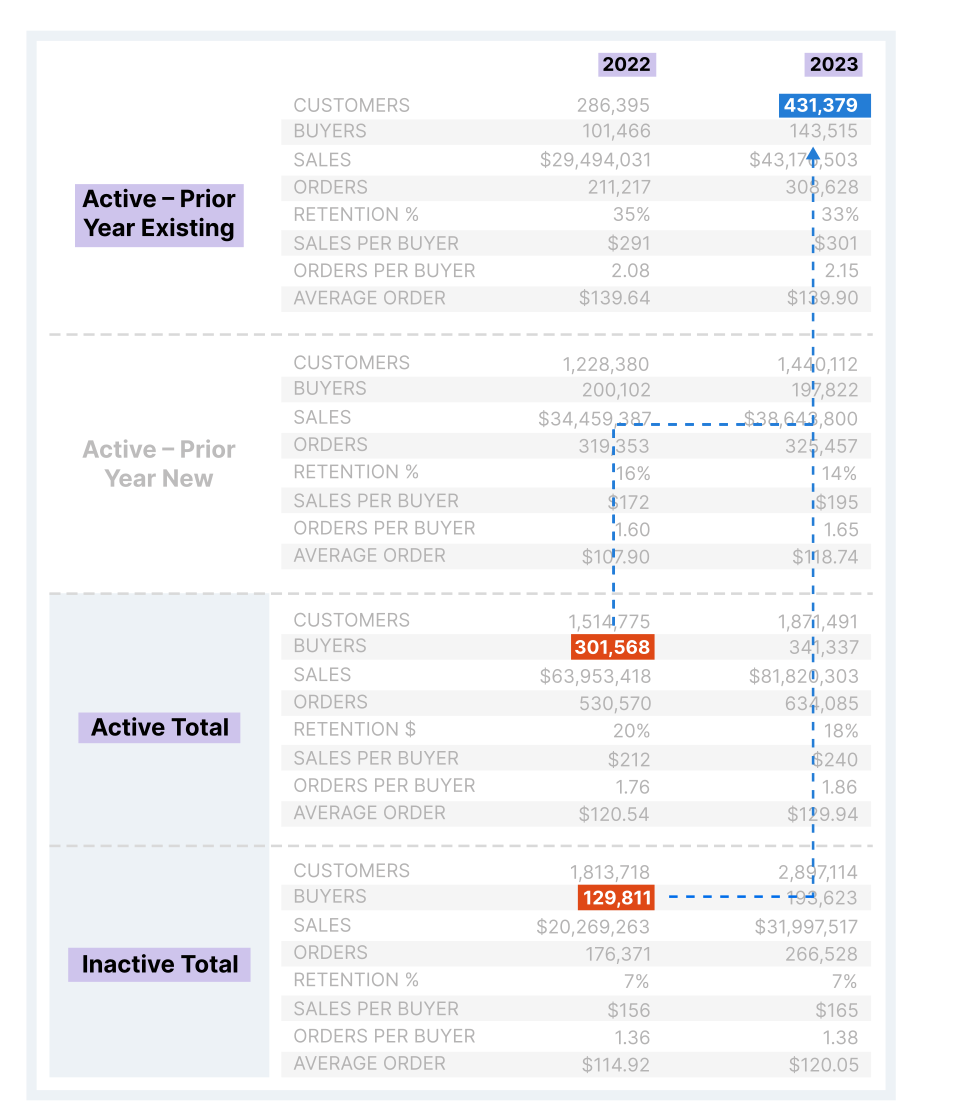
When customers become inactive or churn, they move down and to the right.
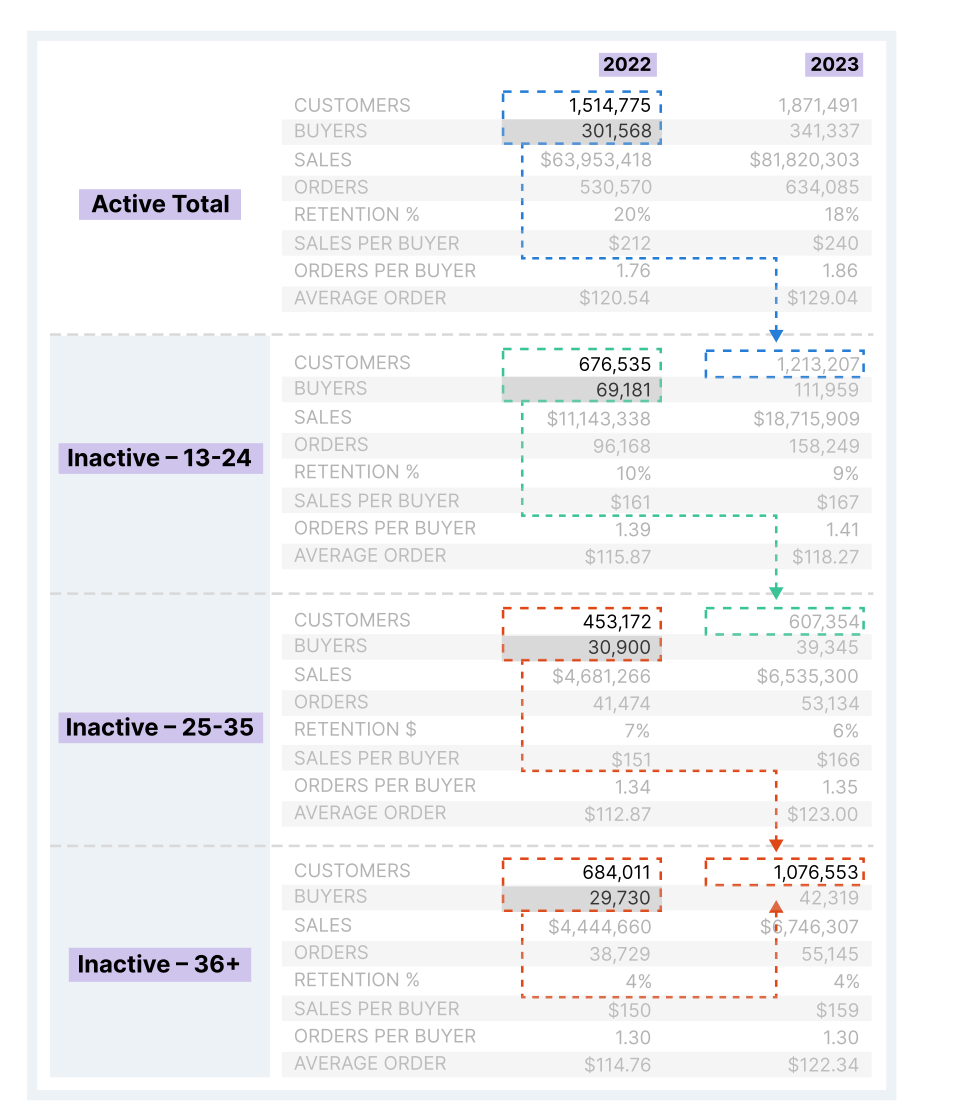
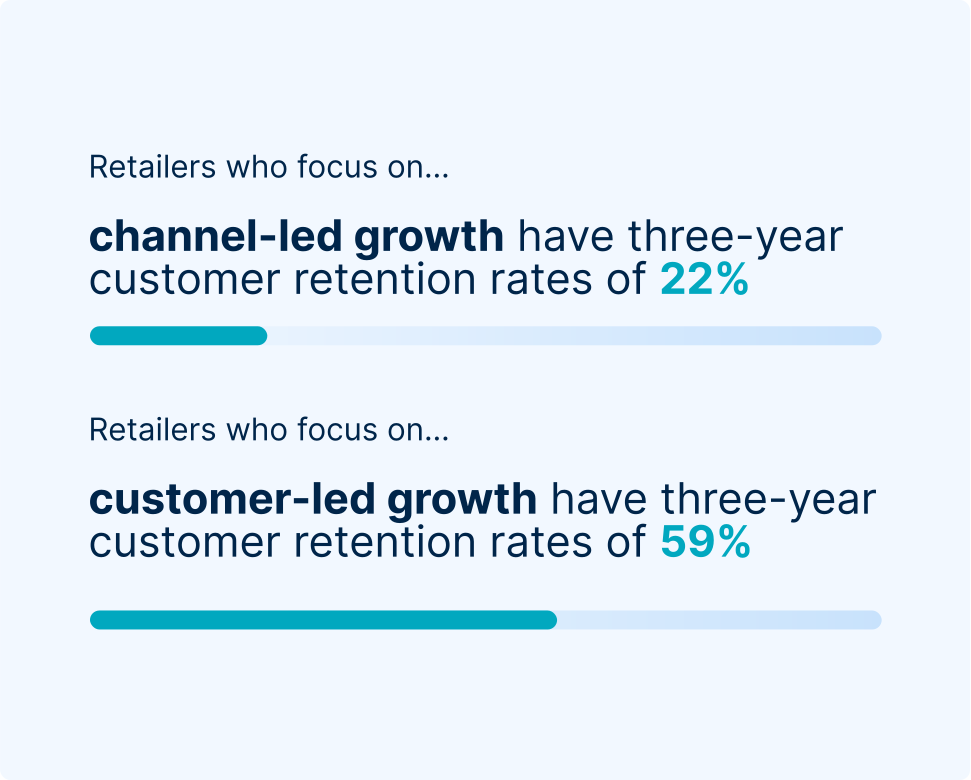
A focus on customer movement is a stark difference from the way most teams operate, which is with a concentration on channel metrics. And while most mature retailers and brands have this data, few have a central owner for monitoring, managing, and impacting performance in this manner.
During a Customer Movement Assessment, one of our clients saw that their long-term customers are extremely loyal. Their average order value is high, and they buy regularly — but infrequently. There are not enough of these long-term, retained customers to sustain the business.
The marketing team was promoting high-ticket items to this group, with no effect on frequency. The team didn’t want to promote lower-cost accessories because that would negatively impact revenue-per-email. In the long term, selling more accessories would have increased both revenue and cash flow. To the email team, revenue and cash flow were abstract and therefore, less important. Their KPIs were tied to revenue-per-email and ROAS. By focusing on a channel metric rather than a customer metric, the team was reaching their goals, but undermining their contribution to the business.

Broad growth strategies fail — customer movement gets surgical
Increased retention rates are a critical part of the virtuous cycle that customer movement help can create, producing steady growth in revenue and free cash flow. Retained customers spend dramatically more than new ones — 69.2% more, according to Bluecore’s 2024 Customer Growth Benchmarks Report.
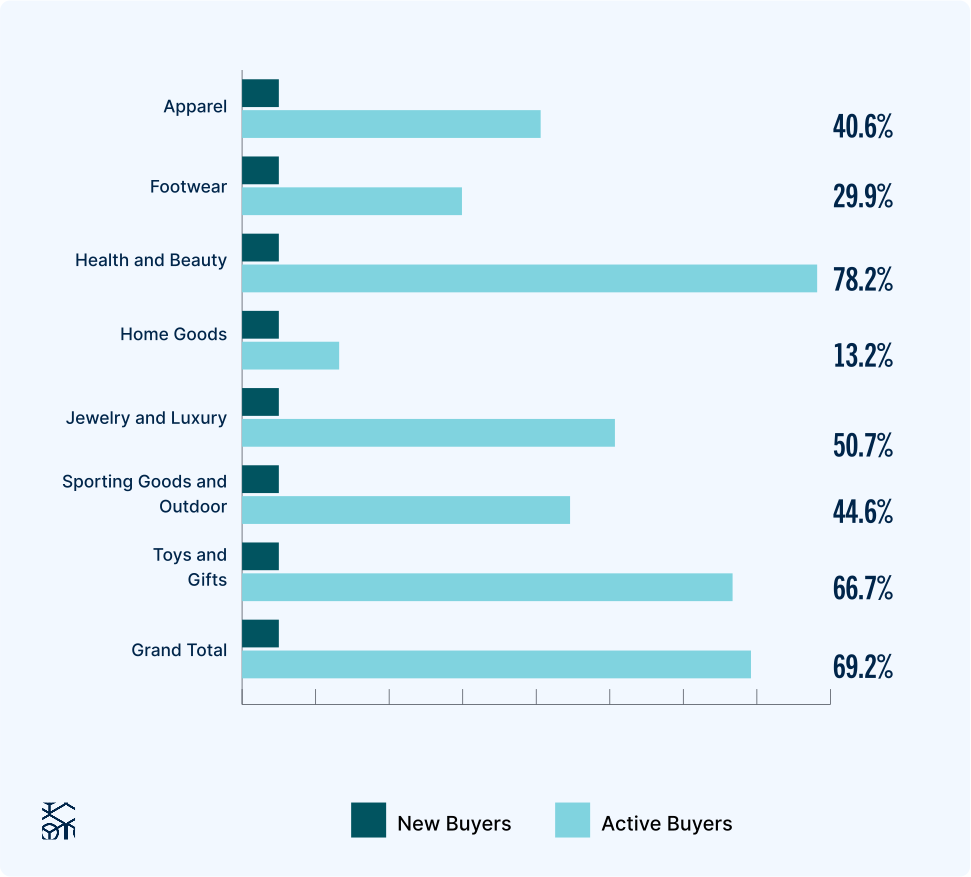
A customer movement analysis diagnoses the health of the customer file and demonstrates the behavior of each cohort. This allows your teams to come up with strategies to influence engagement and conversion where it is needed most, versus broadly across acquisition and retention. These strategies should look different for every brand and are likely different every year based on external factors. Examples include decreases in organic or direct traffic impacting acquisition, or the differences in how customers acquired during COVID purchase and/or reactivate. Strategies should also shift by season based on a business’ unique peaks.
Peer benchmarking is a critical component to strategy development. Bluecore, for example, supports customers with custom-built peer groups so that leaders can understand how their retention, survivorship, frequency, AOV, and more perform compared to a set of peers so that plans to impact customer movement are based on the realities of their specific market.
If your AOV for active customers is already on par with peer organizations, it might be difficult to meaningfully increase it. Benchmarking will also show where an organization is falling behind its peer group, and where there is a higher likelihood of improving performance.

The future value of your customer file — and your business
A Customer Movement Assessment, along with peer benchmarking, will allow you to understand current performance and then create a trended bottom-up forecast to understand future performance. We’ve found this bottom-up forecast to be more accurate than the top-down approach used by many brands. By removing channel bias, attribution methodologies, spend dynamics, and other factors that are not directly related to the actions of your customers, you’ll have a more accurate picture of your growth trajectory.
At the heart of the trended forecast is a formula:
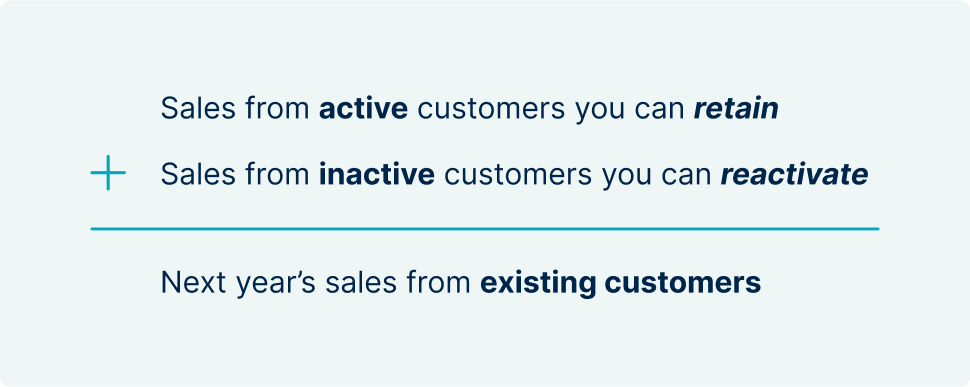
This formula shows that any customer you fail to retain this year hurts your ability to make your numbers next year. Any shortfall in revenue coming from existing customers will need to be made up by new customers. But those new customers are generally more expensive to acquire and convert, and therefore less profitable.
A trended forecast, rooted in customer behavior, allows the CMO, CFO, and CDO to work together to determine appropriate spending and investment. This forecast, based on customer performance, will show if you’re trending to meet your targets, based on what you already know about the behavior of your current customers. If you’re likely to miss the targets, you’ll be able to project the size of the gap. You’ll discover how many new customers you’ll need to make up any difference, and how much it might be worth spending to acquire them.
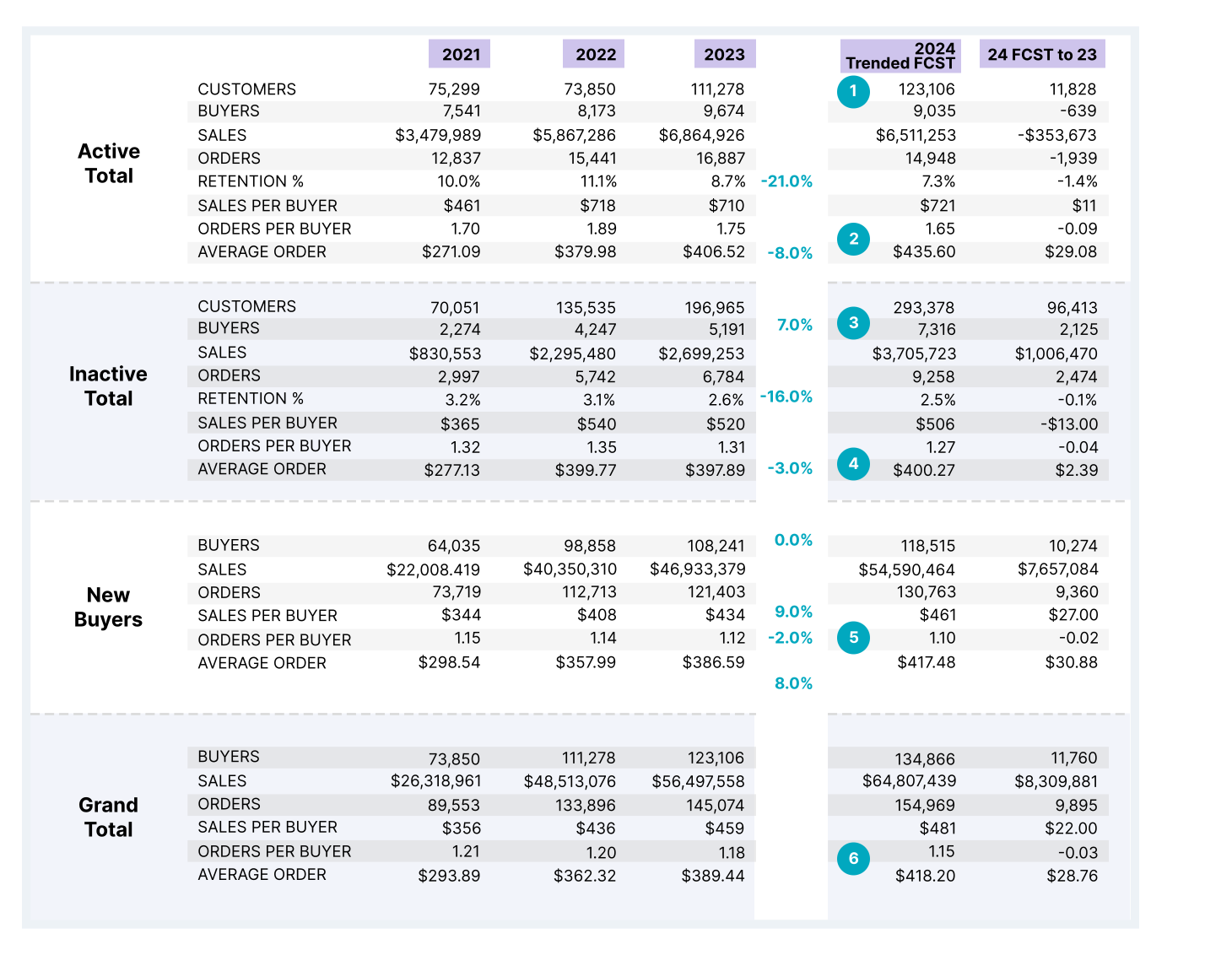
A Customer Movement Assessment goes into much more detail on the strengths, weaknesses, opportunities, and risks that your organization might encounter with each cohort. But even with the basic analysis outlined above, your teams will probably have some decisions to make. And they will have the data they need to make those choices wisely.
They’ll be asking questions such as:
- If we make up our gap entirely with new customers, how many will we need? How much will it cost to acquire them? What is their margin contribution likely to be? It’s always more cost-effective to focus on existing customers. But because no brand retains 100% of its customers, customer acquisition needs to be both ongoing and efficient.
- If we look to close our gap by getting more sales from existing customers, which group of existing customers should we focus on?
- Should we try to get more sales from customers we’ve acquired in the past year? Or are long-time loyalists a better bet?
- Most likely, your team should try to encourage conversion among multiple cohorts. In that case, how many second-, third-, and even more frequent purchasers do you need to convert in order to meet your sales goals?
Mitigating inventory risk with customer movement
These same techniques can be used to reduce inventory risk. Traditionally, brands try to mitigate that risk by pushing merchandise through channels such as in-store, digital, wholesalers, and partners. That’s of limited effectiveness, as seen by high rates of one-and-done shoppers, low retention rates, and customers who expect to buy only at a deep discount.
Open-to-buy planning and traditional merchandising planning based on territories and inventory turn do not consider the dynamics of the customer file. By marrying this planning with deep understanding of customers based on a Customer Movement Assessment — one that includes location, predicted purchase modeling, category preferences, and other factors specific to a business — leaders can connect merchandising, retail, ecommerce, and marketing to create a demand model based on the customer file.
This enables marketing to build strategies designed for each cohort and each individual. That may mean acquiring new customers based on the future assortment, pushing customers near brick-and-mortar locations to store, maintaining active customer frequency with the right set of products, or reactivating specific segments of lapsed customers. The combination is more predictable, reliable, and efficient, producing more working capital for the growth of the business.
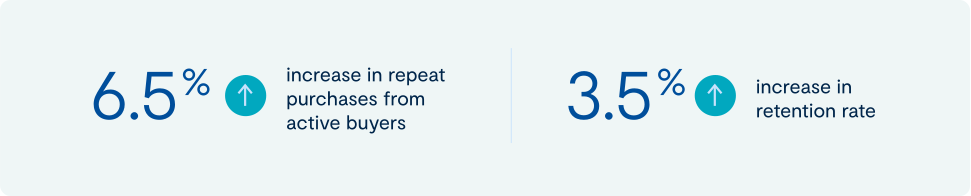
With customer movement, brands have better control of their growth. By using strategies based in a customer movement framework, the global brand that was reluctant to promote lower-priced accessories eventually started doing so, increasing their purchases from active buyers by 6.5% and their retention rate by 3.5%.
Without customer movement, functions from marketing to merchandising to finance lack a common framework for addressing the only force capable of driving the business forward: The movement of customers through the lifecycle and turning inventory.
Without a common approach to understanding the customer file — its value, strengths, and weaknesses — retail executives are at the mercy of a market that’s increasingly volatile and unpredictable. Customer movement allows executives to address their biggest risks, from inventory to customer behavior, while helping organizations increase cash flow today and simultaneously paving the way for long-term sustainable growth.
Assess your customer movement
Our Customer Movement Assessment helps retailers aim their investments and strategies at the highest-priority growth opportunities within their customer base. Conducting an in-depth analysis of your customer file across active, inactive, and new buyer cohorts, our retail strategy team makes surgical recommendations for capitalizing on incremental growth opportunities.
In addition to the analysis, you’ll receive peer benchmarking for purchase frequency, survivorship, new buyer penetration, and average order value growth, prescriptive campaign recommendations, and a full strategy blueprint for how Bluecore can help you achieve your highest growth priorities.
Click here to request your own assessment and join the customer movement.