




Using Insights to Turn More Shoppers into Customers and More Customers into Frequent Buyers
This week’s Coffee and Commerce focused on an important retail marketing strategy – customer movement – and the role it needs to play in retail holiday planning.
Customer movement is the approach of turning anonymous shoppers into known and moving them through the funnel effectively. Customer movement turns more:
- Shoppers into first time buyers
- Buyers into repeat buyers
- More repeat buyers into loyalists
- More lapsed buyers into active buyers
With a packed house, I opened the conversation with the sobering data that consumer spending leading up to Black Friday/Cyber Monday (BFCM) is in a challenging place. Some reports project holiday spending in 2023 to be closer to 2019 levels than 2022.
We discussed how a focus on customer movement could provide a line of sight for retailers to navigate the challenges and drive revenue by striking a balance between acquisition and retention. BFCM is often focused on short term acquisition but it is also a great time to think about retention and create loyal customers that will drive higher sales throughout the next year. Last year during BFCM, 37% of shoppers were first-time buyers, which is expected, but another 31% were fifth-time buyers or more. Brands can use BFCM to learn more about first time purchasers in order to get more of them to buy for a second (or fifth!) time. Even for brands that have not committed to a strategy for BFCM, there is time to create a great customer movement strategy that will drive real revenue improvements.
It Starts with Identification
Identification is the foundation of customer movement. Once a retailer can capture a shopper’s identifier (e.g. email or phone number) and their signals, they can put in place triggers and marketing experiences that are relevant for individual shoppers based on their behavior, status and based on product information.
Take this very real example: last year, most retailers were unable to identify 74% of their visitors over BFCM. These folks came, browsed and left – without buying anything – and now they are unreachable. Retailers who are able to maximize ID capture on the site, and collect the rich signal along with it, are able to automate communications and experiences, like email triggers, to drive customer movement most effectively.
Breaking Down Customer Movement Opportunities
Bluecore’s retail strategists, Jackie and Sara, presented a breakout of the different types of shoppers and insights that are available for retailers looking to create marketing triggers to drive customer movement. Jackie noted that Bluecore thinks about customer movement all year and helps retail clients create buckets of customers and content at the ready to engage them leading into the holidays.
These buckets fall into four quadrants that represent the spectrum of typical site visitors at any given time: on one axis is Non-buyer to Loyal Buyer and on the other is Purchased to In-Market.
Another way to think about shoppers is by four statuses: passive shoppers, first time buyers, active purchasers and lapsed purchasers
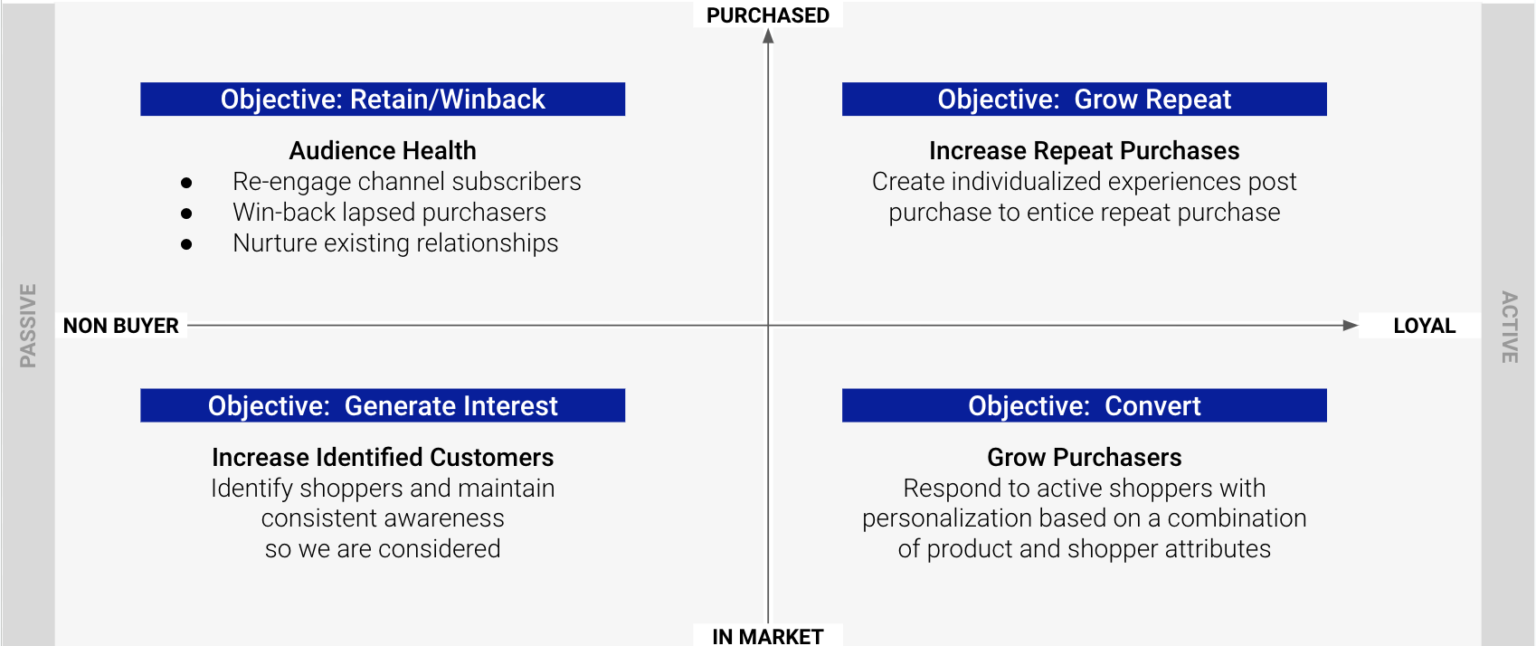
The concept of customer movement is to grow customers that have been identified into more active shoppers, no matter what their current status is. With buyers, the goal is to not just increase the number of identified purchasers, but also to get each purchaser to make additional purchases.
Sara shared an approach for understanding more of the moments that make up a retailer’s unique shopping journey.
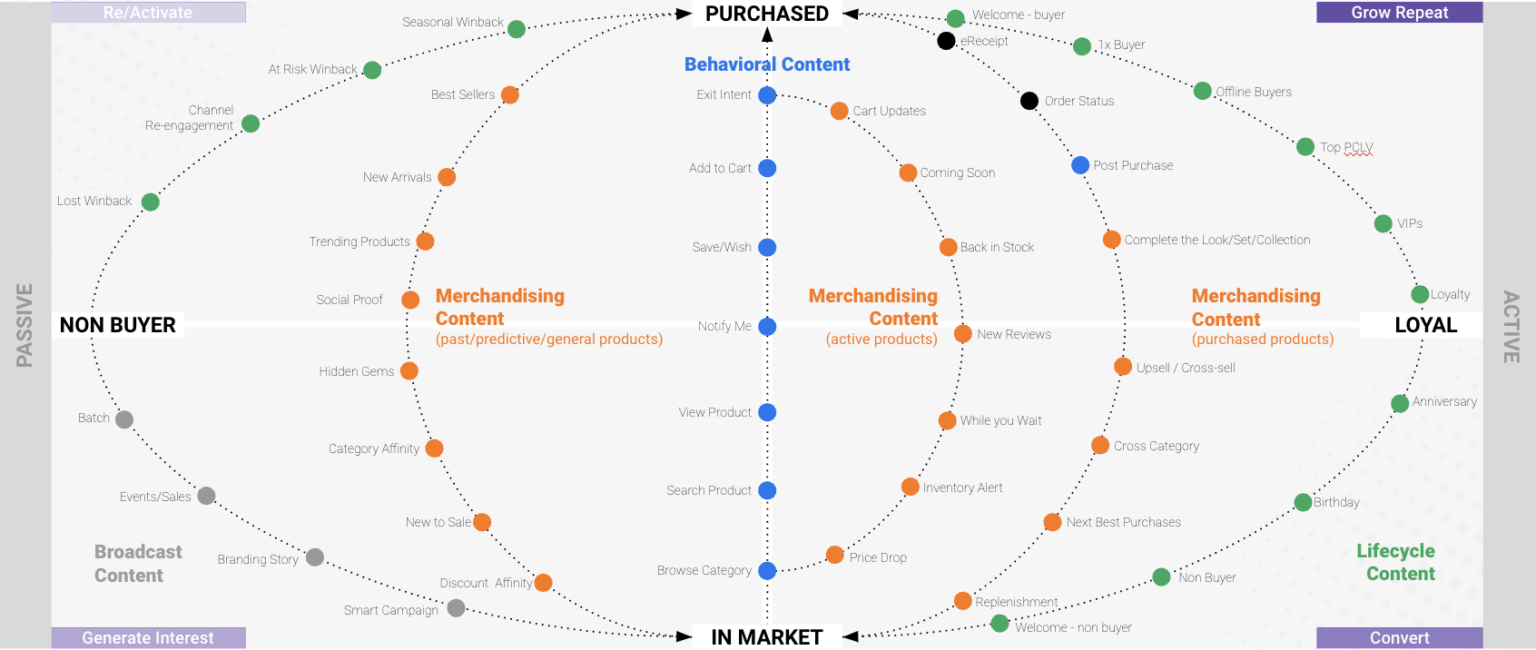
Active Shoppers – primary movement opportunity.
The prime opportunity is with an active shopper, be that a first-time buyer or a loyal buyer. It’s important to focus on giving active shoppers the right message and take away noise.
Here’s where identification comes in. It is vital to know that someone is on the site and in-market. It’s also critical to be able to know as much as possible about that shopper and about your own inventory to drive relevant experiences.
Retailers can draw on two different categories of insights:
- Behavioral content which shows which actions they have taken such as browsing and searching and adding to card and purchasing.
- Product attributes – status like low inventory, sales, moving quickly
These two categories of insights become cues for retailers to take action and engage.
For example, an often overlooked opportunity is to move a first time buyer towards a second purchase, and nurturing with post-purchase streams is a great way to do it.
- Immediate order confirmations and receipts
- Thank you with additional sales opportunities
- Use product data to upsell and provide recommendations
- Introduce them to new affiliated categories
Bluecore CMO Jason Grunberg noted that “hidden gems” are critical to upsell. These are products that are high-converting but don’t often get a lot of play in creative. These could be used for “stocking stuffer” campaigns, gift lists and for bundled offers.
After an immediate purchase, retailers can also start to segment based on what a retailer knows. If someone is a loyalty member or offline buyer, those signals can help to create relevant triggers.
The next phase is for the period of time after a shopper is active to continue outreach with relevant content even if they didn’t purchase a specific product. Perhaps they put a pair of shoes in their cart or browsed a certain category. This activity can be used to engage and make a shopper more active.
Steven Cohen, Director of Growth for Topo Designs noted that Bluecore’s approach is helpful for uncovering new ideas to engage consumers. He is preparing for BFCM with these touchpoints.
Warming up passive shoppers. Broadcast content is important for more passive shoppers and shoppers who aren’t in-market at that time. The goal is to stay in the consideration set and keep the brand top of mind.
Merchandising programs tend to spike and perform well during the holidays. They can be valuable ways to assist gift givers and reengage passive shoppers that haven’t bought since last BFCM.
The wishlist is an important element to creative shopping engagement during BFCM season. Providing alerts if an item on the list is on sale, recommendations to add to the list based on what they’ve added, these elements are all ways to keep the list fresh, spark ideas, and of course, drive purchase.
If you have a wishlist capability, use batch messaging to remind all customers that it’s available. Even if they don’t convert, it provides great insights about what they might want for themselves or what they might purchase for a gift.
Examples and Triggers to Try
Bluecore noted the sheer size of opportunities for adding more triggers to the customer journey – even for passive shoppers.
But retailers shouldn’t be concerned that they will be over-marketing. Each customer will only receive the right trigger. Rather, having a lot of different triggers simply increases the number of people that will get a relevant outreach based on important behavior and product activity.
Many Bluecore customers leverage category affinity to bring shoppers over from a favorite category for example, moving from boots to sandals or sneakers.
As part of a post purchase stream, utilizing the “next best purchase” model helps to predict what the customer is likely interested in buying next, locking in relevant recommendations for that second purchase.
Karina Rubalcaba, Sr. CRM Marketing Specialist for Titleist is more focused on content rather than messages as an overall approach. Specifically, she wants to use affinity to create a more relevant content experience.
Dianna Lyngholm, Director of Creative Services and eCommerce for FUN.com noted that she hasn’t focused on BFCM yet because Halloween comes first. Jackie provided some visual examples of new ideas to employ. While abandon cart and abandon search is a standard trigger, “while you wait” for out of stock items can keep people engaged.
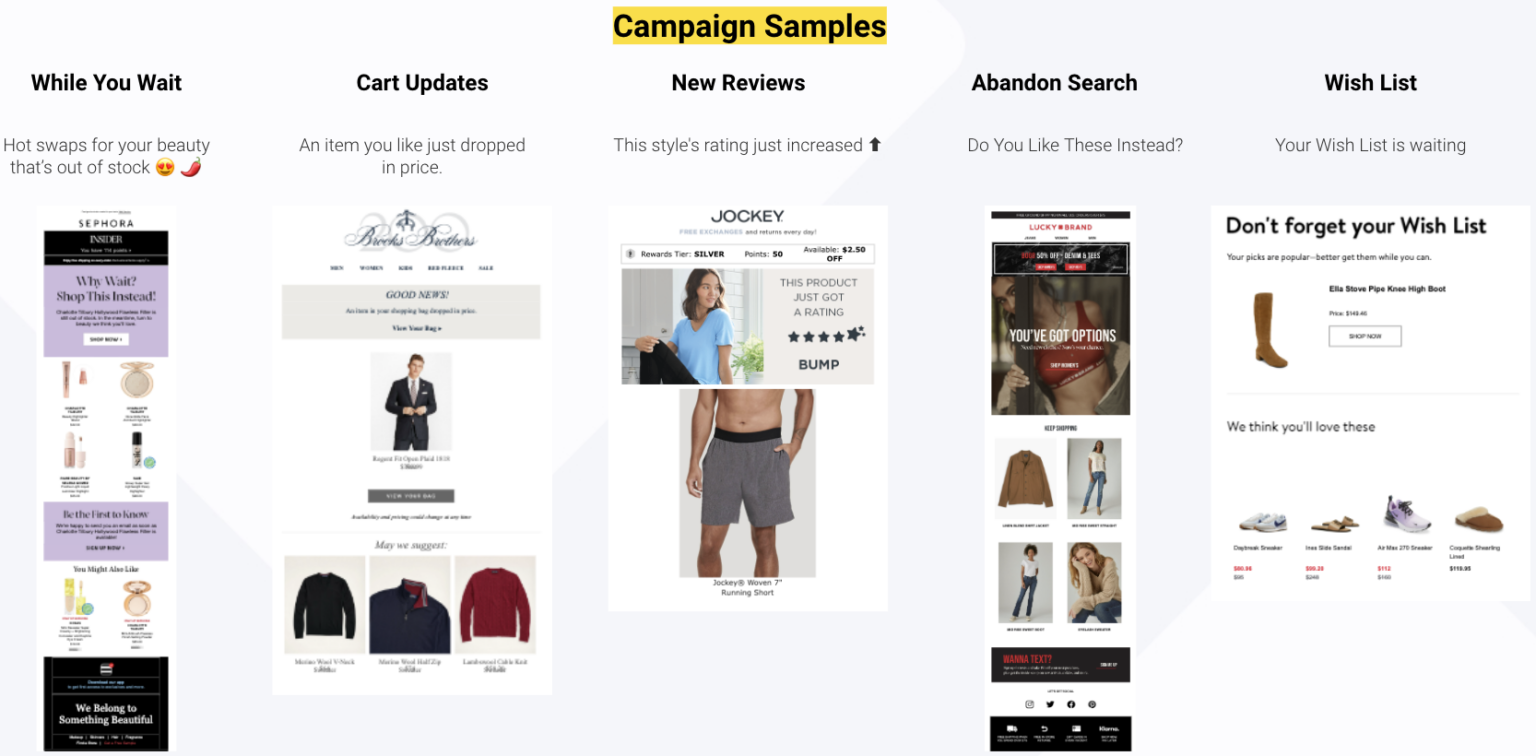
With abandoned cart or abandoned search, combining that message with discounts, or bundling different offers into an abandoned cart offer that has been proven to work with similar customers.
Incorporating Social Proof and Urgency
The Bluecore team dove into best ways to incorporate social proof and timely information about product availability. This tactic can engage shoppers with a sense of FOMO, and during the holidays, where there is a finite period of time and more urgency. Worries about inventory availability and shipping dates are real. People want to know if a product stock is running low or if shipping windows are closing.
Popular notifications to add urgency are:
- Low stock
- Best seller
- “Sale ending soon”
- Back in stock
These triggers can be combined with shopper data to get more personal, such as low stock on recently browsed products, or back in stock for a specific color or size preference.
Another way to create urgency is to get shoppers ready for holiday sales early. Retailers can use gaming elements to have shoppers shop early to “win their cart” before discounts are employed. Nordstrom, prior to a big annual sale, they tell people to start stacking items in their cart to be able to take advantage of the sale the moment it hits. This provides great insight even if they don’t buy everything.
Lauren noted that Old Navy would employ the same strategy before the Friends and Family sale, especially when someone is alerted that their cart is eligible for a discount. She noted that it’s good to highlight category affinities to distill the message down to something more relevant so they aren’t landing on a generic page when they do respond to a message.
I noted that “While You Wait” notifications were popular for NOBULL, which transformed their retention efforts. The triggers were set up to be automated, which put their team at ease in an environment where a lot of inventory is moving in and out of status like out of stock.
Jason noted that one thing that’s been effective is to incorporate planned price drops around specific sets of items. Then the team knows that there are items that are popular from a search or browse perspective that might be due to price. This gives a team the ability to unlock those triggers based on anyone who has browsed or carted throughout the promotional schedule.
I also noted that price drop isn’t for every brand, even during BFCM. That’s a place where a new arrival or “running low” message could provide some urgency. Trending and social proofing in general are valuable during the holidays to help gift buyers know what might be well received. “Top gifts” can inspire and spur purchase.
These campaigns can also be great acquisition tools – having someone to sign up for a back in stock alert or to be alerted when a new item arrives before the holidays.
Messaging For Gift Givers and Receivers
During the holidays, it’s valuable for retailers to identify who is a gift giver vs purchasing for themselves. If a retailer knows someone is buying for someone else, they can deliver a different concierge experience than someone buying something they like
Even if these things aren’t in place for BFCM, the high volume of the holiday season can be used to collect insights that can be used throughout the year.
The Bluecore team reminded the audience not to forget to prioritize the gift recipient – knowing if they received a gift, using opt-in of course, can help create a more personalized experience if they come back. During the purchase process, retailers can ask outright “is this a gift?” If that data can be incorporated into a segment, it can drive more relevant outreach.
For the gift card getters, retailers can get the email address and get approval to deliver it digitally to start a campaign to get them to use their card, even if you don’t know who it is. This can be a great way to increase activity in January when the holidays are over.
We reminded the group that a lot of people buying in the next few months are one time buyers, now is the time to think through which data points to collect that can help with ongoing marketing in the new year. If someone is a gift giver, a nurture campaign for them could be different than someone who buys for themselves.
I also noted that it goes back to the signals driving the strategy. Don’t blast new customers with things they aren’t interested in. Look at their behavior and think about relevant outreach.
Poll Data – Where Retailers Stand Today
At the end, Bluecore made some time for a couple of audience polls. Only a few of the participants noted that they were confident that they had the identification and site capture in place.
Bluecore then asked the participants what kinds of triggers they are running outside of abandoned cart
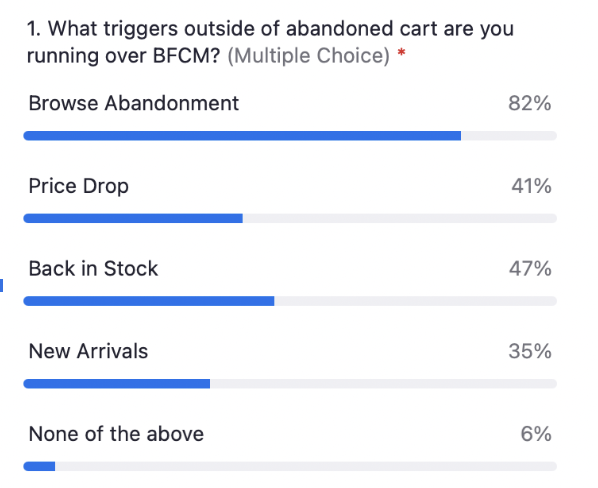
When asked which will perform the best, Diana noted that price drop is most valuable for them. Market is likely soft for demand during Halloween. People are likely going to look for deals this year.
Bluecore ran another poll to see if any of the participants have triggers in place to move first time buyers to the next purchase.
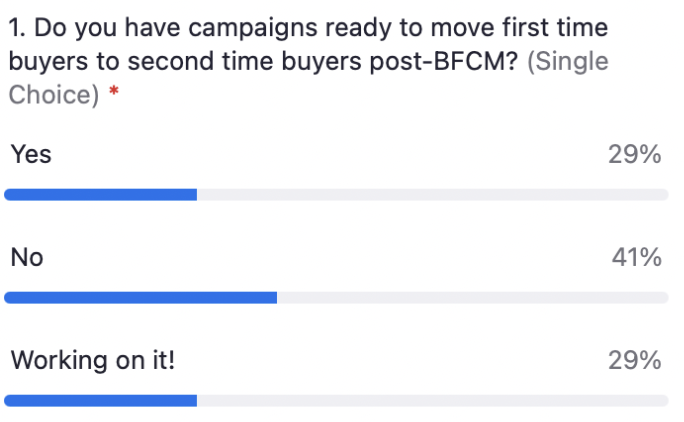
Post purchase is similar to abandoned cart, where there is standard follow-up. To make it better, add something more specific such as “complete the look” or upselling with complementary products. If other customers like the shopper have bought other products, make a recommendation.
Brands also use “replenishment” to get ahead of a buying cycle to put it in their mind as it’s about time to get another one before they run out or want another one.
Bringing Customer Movement Home
Last BFCM, nearly three quarters 74% of site visitors were unidentified, so retailers were unable to ever reach out to them again. Identifying visitors and capturing their activity is the critical piece of the puzzle to support a robust triggered marketing program.
Sara noted that many companies assume current customers are identified on site, but that’s not usually the case if they aren’t logged in. Not only is it important to identify a customer, retailers also need to look back at activity through the last holiday season to create a full picture of a shopper and understand where they fall along the customer movement curve.
There are still a few months to get identification and behavior analysis in place to see what kind of triggers could be most valuable for each identified shopper.