



4 Copy-Paste Prompts Retail Marketers Can Use Today to Drive Performance
At our latest Coffee & Commerce session, we focused on turning AI ambition into action for retail marketers; working with the stack you already have, proving one win per channel and compound learnings quickly. With email engagement softening, high acquisition costs and cross-channel fragmentation, small AI-led boosts in relevance and timing can drive outsized impacts, especially in the pre-BFCM window.
We created 4 copy and paste prompts you can add to your LLM of choice (ChatGPT, Claude, Gemini) to uncover content optimizations, testing opportunities, and quick wins your team can ship fast.
How to get the most from these prompts:
-
- Be prescriptive: paste brand voice, legal constraints, offer calendar and any relevant data context so outputs are on-brand and actionable
- Speed beats perfect: prove one win per channel first and then scale to cross-channel
- Stay curious: test your theories, guard against bias, and review LLM outputs with a critical human eye
Prompt 1: Competitive Scan
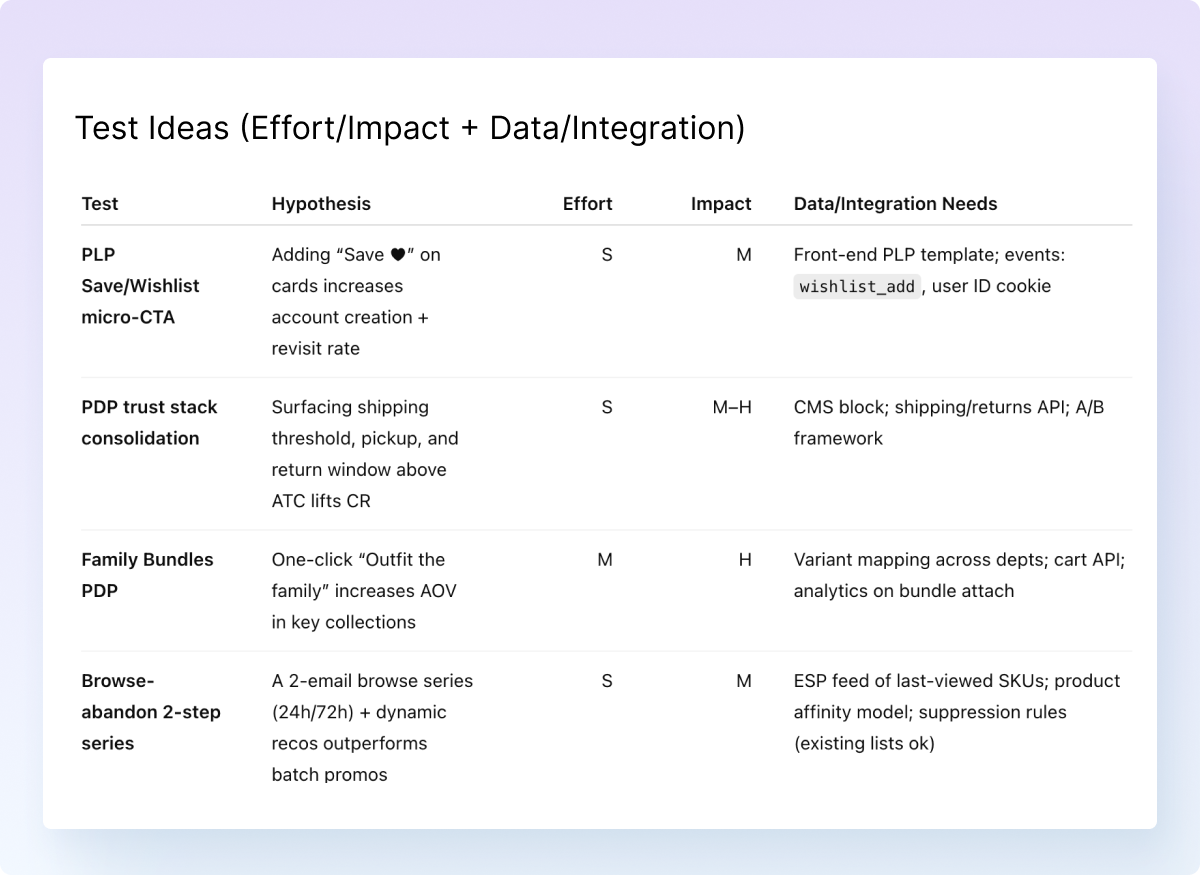
Try a fast competitive gap scan to answer “What are they doing that we’re not?”. Have an LLM audit your top 3 competitors across site flow, lifecycle triggers, email frequency/creative, and merchandising rules to surface quick wins, parity moves, differentiators and a test-ready 30-day backlog with effort, impact and data needs.
Prompt 1
Analyze our top 3 competitors: [Competitor A], [Competitor B], [Competitor C]. Review their site flow (Homepage > PLP > PDP > Cart), lifecycle triggers (welcome, browse, cart, wishlist and abandonment), and email frequency and creative.
Deliver:
- Quick wins
- Parity moves
- Differentiators we can leverage
- Test ideas with effort/impact and data/integration needs
- 30-day backlog
Sample Response
Prompt 2: Email Updates
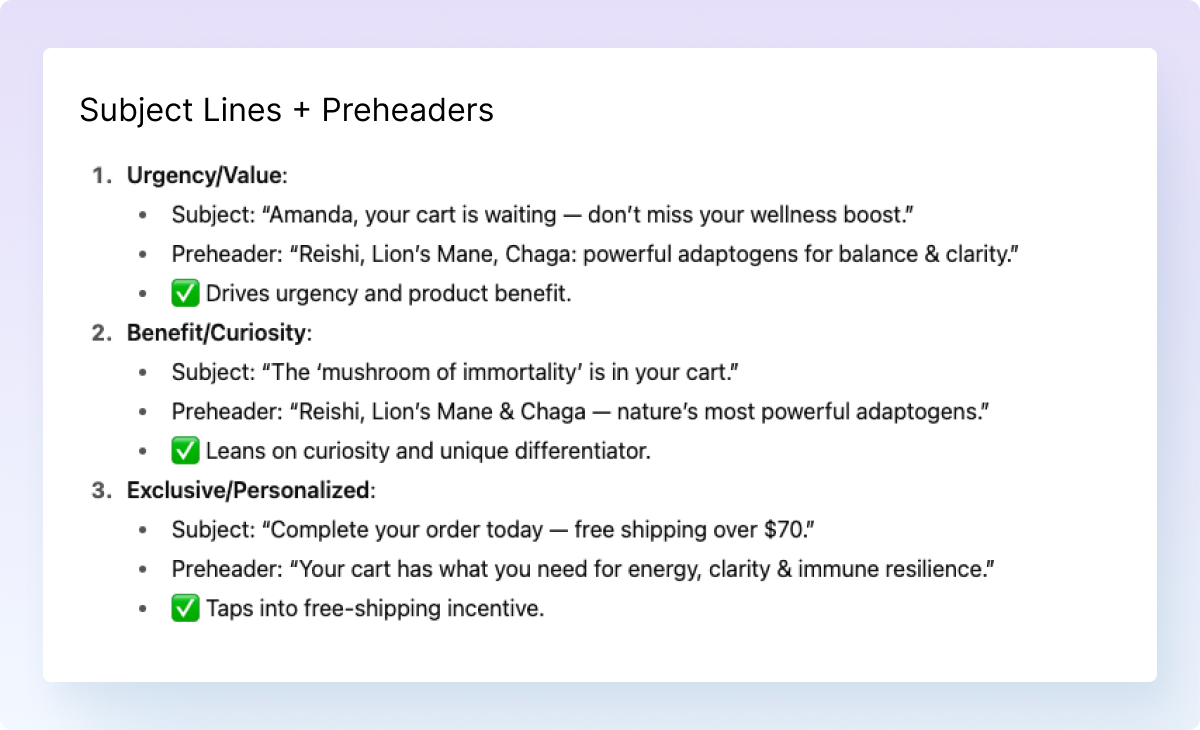
Optimize every send by turning a single email into a performance opportunity. Build a Best Practices Checklist to create an on-brand set of criteria and include how to boost Gmail relevance signals, protect sender reputation and stay digest-proof for iOS mail that you can upload each time for consistent feedback.
Prompt 2
Using the Bluecore Email Best Practices Checklist provided, critique the email below and return the 9-part output format. Prioritize actions that increase Gmail relevance-ranking signals (replies, stars, moves to Primary), lift conversion, and protect sender reputation.
Ensure the creative is digest-proof for iOS Mail and note any Annotations opportunities that align with timely offers.
Conform to brand voice and legal constraints as uploaded in my document.
Here is the email: [paste email]. Here is audience/context: [paste details].
Sample Response
Prompt 3: Benchmarks
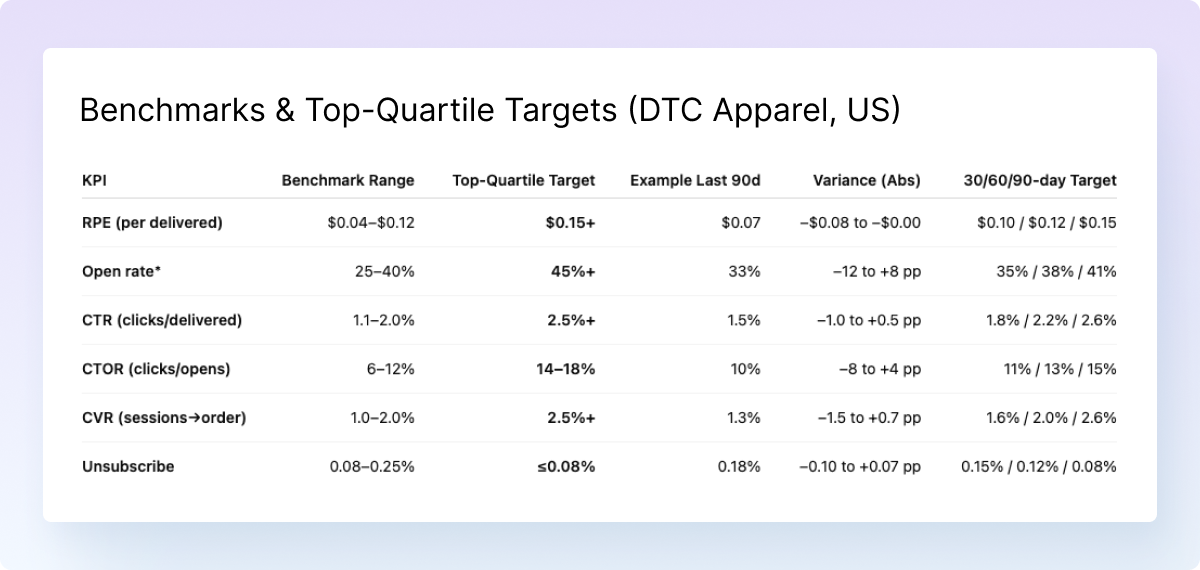
Stop guessing and set targets with confidence by grounding your plan in category benchmarks. Ask your LLM of choice, using your company size and named competitors, to return KPI ranges and top-quartile goals for RPE, open rate, CTR, conversion, unsubscribe, send frequency, and list growth with notes for seasonality and BFCM variability you can prioritize where to focus next.
Prompt 3
Act as an email benchmarking analyst for DTC retail. Using the context below, provide up‑to‑date benchmarks tailored to my peer set.
Context:
- Category/vertical: [e.g., apparel/beauty/home]
- Region: [country/geo]
- Mailable list size: [#] | AOV: []∣Revenue:[]
- Business model: [DTC/marketplace/omnichannel] | Price point: [value/premium/luxury]
- Send mix (last 90 days): [X% promotional, Y% triggered] | Avg weekly cadence: [#/sub/wk]
- Mailbox mix: [Gmail %, Yahoo %, Outlook %, iCloud %] | iOS MPP share: [%]
- Acquisition mix: [paid social %, search %, retail %, referrals %]
- Last 90‑day actuals (if available): [RPE, OR, CTR, CTOR, CVR, unsub, complaint, bounce]
- Seasonality: [peak months] | BFCM performance last year: [highlights]
Deliver:
- Benchmark ranges AND top‑quartile targets for: revenue per email (RPE), open rate (note MPP caveats), click‑through rate (CTR), click‑to‑open (CTOR), conversion rate, unsubscribe, spam complaint, hard/soft bounce, send frequency, list growth, and deliverability/inbox placement.
- Breakouts by: message type (promo vs triggered: welcome, browse, cart, post‑purchase, price‑drop, back‑in‑stock), mailbox (Gmail/Outlook/Yahoo/iCloud), device (mobile/desktop), segment (new, active, lapsing, lapsed, VIP), and seasonality (BAU vs BFCM).
- A table comparing: my last 90‑day actuals vs benchmark range vs top‑quartile, with variance (+/‑) and recommended targets for next 30/60/90 days.
- 5 highest‑leverage actions to close each major gap (prioritize by effort/impact and note data/integration needs).
- Notes on methodology, definitions (e.g., RPE per delivered vs per sent), and how MPP affects open/CTOR interpretation.
- Cite credible sources with date stamps; if you infer values, state assumptions and provide confidence levels.
Output format:
- Summary bullets (key gaps and targets)
- Markdown table for KPI comparisons
- Ranked action list with expected lift ranges and risks
- Questions/assumptions to validate
Sample Response
Prompt 4: BFCM Test Plan
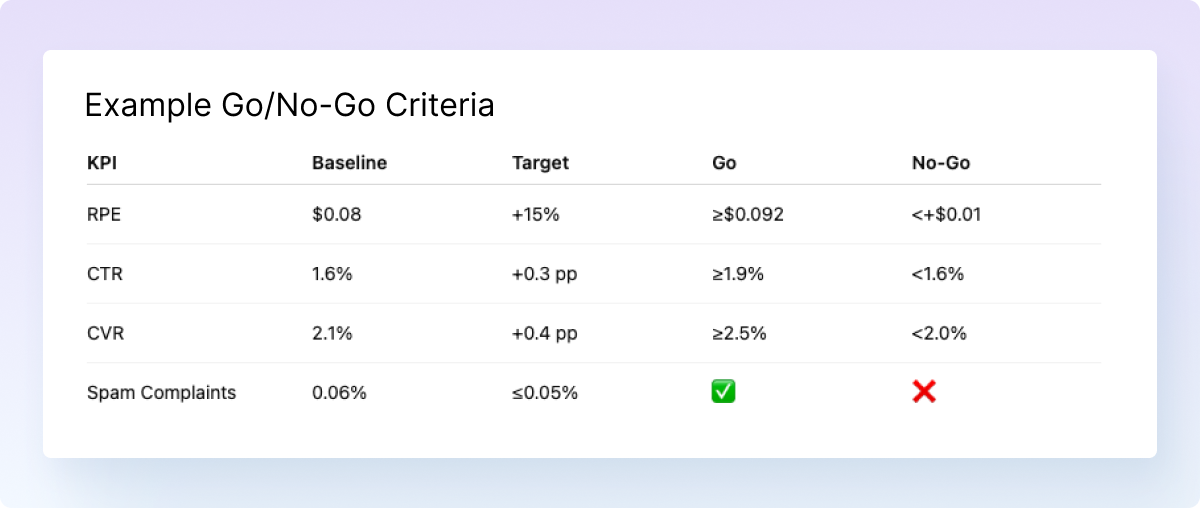
Make the most of the holiday-rush by using the two-week pre-BFCM window to run fast, low-risk experiments that sharpen relevance and protect deliverability. Plug last year’s results and this year’s offer calendar into your LLM of choice to produce a cross-channel plan with prioritized tests, Gmail Promotions Annotations, engagement-based throttling/list hygiene, a dated calendar, hypotheses, success metrics, QA and clear go/no-go criteria you can execute immediately.
Prompt 4
Using last year’s BFCM performance and this year’s offer calendar [paste data], create a 2‑week pre‑BFCM test plan across Email/SMS/Onsite. Include: prioritized tests (subject lines/preheaders, CTA hierarchy, image‑to‑text ratio, send‑time/throttling, suppression rules), Gmail Promotions Annotations opportunities, and deliverability safeguards (list hygiene, engagement‑based sending, cadence caps). Return: calendar, hypotheses, success metrics, QA checklist, and go/no‑go criteria.
Sample Response
What to do next
- Time box one 60-minute session today: paste a prompt, review outputs with your team and ship one incremental win.
- Join our next Coffee & Commerce, “Winning the Relevance‑First Inbox,” on Wednesday, November 5 at 12pm ET, to go deeper on Gmail Promotions, iOS Primary, and staying “Known” in iOS 26 SMS.